Catalog ID F03 · Feeding
Column-Type Integrated Panel Feeding Machine
Servo-controlled pickup and feeding for insulation and board products entering a composite panel production line.
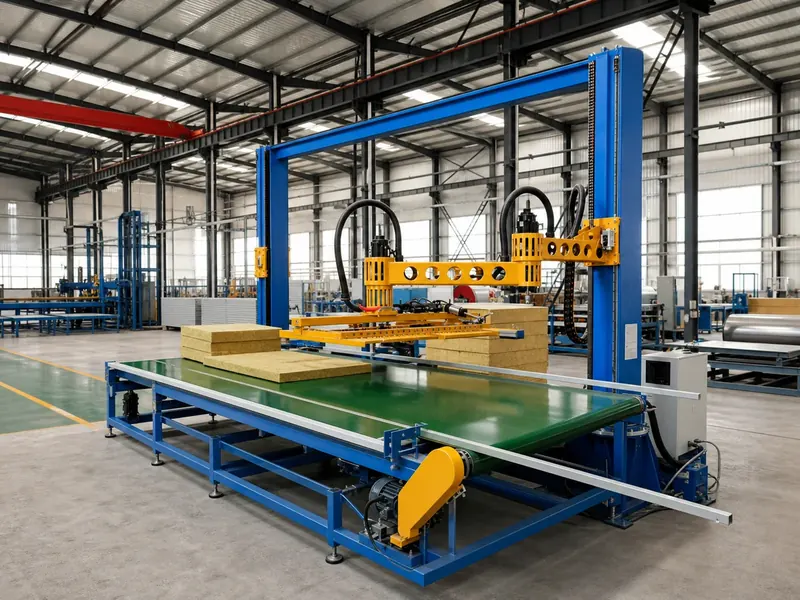
- Operating speed
- Approx. 400 m/h
- Servo axes
- 4
- Air supply
- 0.6–0.8 MPa
- Power supply
- AC 380 V · 50 Hz
Material scope
One feeding platform for multiple panel cores.
- Rock wool and silicon rock
- Magnesium oxysulfate board
- Hollow glass-magnesium board
- Vacuum pickup and pneumatic control
Presentation specifications
| Overall height × width | 4,400 × 2,450 mm |
|---|---|
| Servo axes | 4 |
| Ambient temperature | −20 to 40 °C |
| Installation altitude | Below 2,000 m |
| Control components | Wecon PLC, HMI and servo; Omron sensors |
| Auxiliary components | CPSR vacuum cups, Airtac pneumatics, Mean Well power, Impro reducer, Delixi relays |
Application fit
Where this feeder fits.
This configuration is intended for composite-panel lines that receive pre-stacked flat core boards and need a repeatable pick-and-place feed into the next process. Vacuum suitability must be checked against surface porosity, board rigidity and weight before tooling is released.
Good project fit
- Rock wool or silicon-rock boards presented in stable stacks
- Magnesium oxysulfate and hollow glass-magnesium boards
- New lines or retrofits with confirmed pickup height and transfer direction
- Projects where a sample-board pickup test can be completed before acceptance
Configuration preparation
Identify the board, the stack and the receiving point.
Conceptual enquiry-input diagrams—not a physical motion path, tooling design, installation layout or pickup approval. Show the actual conditions and requested orientation; the supplier must confirm the project configuration.
1 · Board and face record
Link both-face photographs to the material grade, dimensions, individual weight and sample reference. Identify films, texture and porous or uneven areas; a material name alone does not confirm pickup suitability.
2 · Incoming stack record
Provide full-stack and near-depleted-stack sketches, their actual heights, supporting pallet or frame and replenishment location. State who removes wrapping and interleaves. Sketches are not allowable stack-height limits.
3 · Receiving interface record
Show receiving height, requested delivery face and direction, alignment reference and downstream equipment. Identify the controls-interface owner and record replenishment interruptions; these are inputs, not wiring instructions.
The listed approximate operating speed is not a guaranteed complete-line output. Material condition, the full feeding sequence, replenishment and receiver availability still need project-specific discussion. Height and width do not establish the missing overall length or an installed footprint.
Use the detailed core-board selection input guide for the complete record. For prepared strips rather than stacked flat boards, use the rock wool continuation inputs.
- Material type and surface condition
- Panel dimensions, thickness and weight
- Pickup stack arrangement and line speed
- Available height, footprint and utilities
Prepare your feeding project
Record the actual core-board grade, both faces, stack arrangement and receiving conditions.
Core-board selection inputs · Choose a feeding route · Existing-line integration
Blank preparation sheet
Prepare the material record before the enquiry.
Feeding project inputs
Complete the common section and the column/core-board section. Use a separate material record for each board variant; leave unknown values as TBD.
Download feeding inputs (TXT)Attach the matching references
Link the sheet to the supplier material record, both-face photos, stack sketches and receiving layout. This blank file records inputs, not compatibility, performance or approval.
The website enquiry form does not accept attachments. After the initial enquiry, send authorised files to tony.buy@gmail.com; do not send confidential material without permission.
Before requesting an F03 configuration
Does a listed material mean every grade can be picked?
No. Identify the actual grade, board construction, dimensions, weight and both faces. Pickup tooling and sample suitability require project-specific confirmation; the category name is not approval.
Does the catalogue speed guarantee my line output?
No. It is an approximate presentation value. Keep output discussions tied to the actual material, complete feeding sequence, replenishment and receiving-line availability.
Can I calculate the installation footprint from the listed dimensions?
No. The original presentation gives height and width but no overall length. Request the complete project layout and agreed travel/interface scope; do not infer the missing dimension.
Is stacked-board feeding the same as rock wool strip continuation?
No. This page describes pickup and transfer from stacked flat core boards. Prepared-strip continuation has a different incoming arrangement and placement task. Use the continuation input guide for that route.