Catalog ID F01 · Feeding
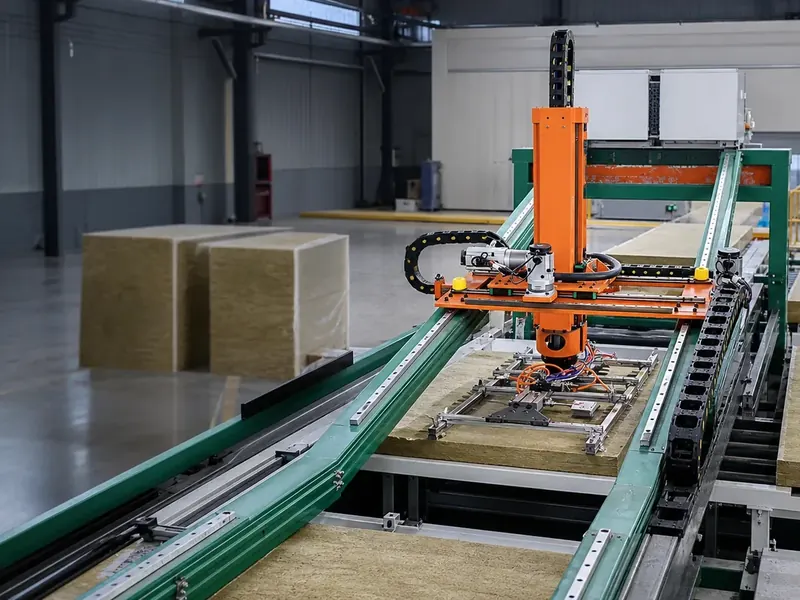
Gantry-Type Rock Wool Continuation Machine
Continuous gantry handling for placing rock wool strips into a sandwich panel production line, with servo positioning and PLC control.
- Operating speed
- Approx. 420 m/h
- Material thickness
- 50–200 mm
- Material format
- 950 / 1150 mm
- Power supply
- 380 V · 50 Hz
Application
Built for repeated continuation work.
The machine uses a gantry frame, servo drive and gripper tray to pick and place insulation material in a repeatable sequence.
- Wecon PLC and 7-inch touch screen
- Aluminium-profile and stainless-steel gripper tray
- Servo motor with RV and precision planetary reducers
- External-bin drive by Sanmen Taili
Presentation specifications
| Overall frame | 5.20 × 1.65 × 2.50 m |
|---|---|
| Main frame section | 100 × 100 × 3.75 mm square tube |
| External-bin motor | 0.75 kW |
| Control | Wecon PLC + 7-inch HMI |
| Drive system | Servo motor, RV reducer and precision planetary reducer |
| Rock wool compatibility | 950 / 1150 mm formats; 50–200 mm thickness |
Material route
Prepared strips, with the receiving line in view.
This page describes the gantry continuation route for prepared rock wool strips. Record how those strips arrive and how the panel line is expected to receive them. Do not assume that upstream cutting or full-board feeding is included.
For an incoming full-board arrangement, review the column-type panel feeding machine separately. For route comparison, use the gantry versus robotic guide.
Approximately 420 m/h is the presentation’s nominal operating-speed value, not a guaranteed sustained project output. Material variation, placement pattern, replenishment and interruptions need a stated evaluation basis.
Configuration brief
Three records make the enquiry easier to review.
The diagrams below organise buyer information. They are not equipment drawings, motion instructions, installation approval or compatibility evidence.
1 · Identify actual strips
2 · Record replenishment
3 · Define the receiver
The documented overall frame dimensions do not establish installed clearance, travel or a complete production-line footprint. Send the actual layout, nearby obstructions and receiving interface for project-specific review.
Configuration input
Send the wool size and line drawing.
We use these inputs to confirm gripper geometry, bin layout and connection height.
- Rock wool length, width, thickness and density
- Line speed and required placement pattern
- Infeed and panel-line interface heights
- Available footprint and preferred material loading side
Prepare your feeding project
Record the prepared strip format, placement pattern, replenishment sequence and receiving conditions.
Continuation project inputs · Choose a feeding route · Gantry versus robotic · Existing-line integration
Project documents
Download the blank feeding-input brief.
Feeding project inputs · TXT
Record actual material, incoming supply, receiving conditions and open questions. This existing blank brief is not a test certificate or acceptance record.
Download input brief (TXT)Need the supporting explanation?
Use the continuation input guide alongside the blank brief, or browse the product download centre.
Before configuration
Common project questions
Does this route include rock wool cutting?
Do not assume an upstream cutting stage is included. Describe how prepared strips reach the continuation machine and identify cutting as a separate project boundary where relevant.
Is 420 m/h a guaranteed line output?
No. It is the approximate value in the source presentation. Sustained project output requires an agreed basis covering the actual material, placement pattern, replenishment and interruptions.
Do the frame dimensions approve an installed layout?
No. The listed frame outline does not establish travel, installed clearance or interface suitability. The buyer’s layout, obstructions and receiving conditions still need project-specific review.
Is prepared-strip continuation the same as full-board feeding?
No universal equivalence is claimed. Identify the actual incoming material and review the column-type panel feeding route separately when the project starts with full boards.
Next step
Send actual strip records, not an assumed setup.
Attach the material photos, dimensional records, replenishment snapshots and receiving-line drawing. Mark unknown values as TBD for configuration review.
Discuss the F01 configuration