What common brief should I send for both alternatives?
Use the rock wool continuation input guide to prepare the same labelled strip drawings, incoming arrangement, receiving pattern, refill sequence and timing record for both configurations. Add the gantry loading-side and frame-layout inputs or the robotic pickup/placement positions as appropriate.
Download the blank feeding input sheet. Request configuration-specific responses instead of changing the material or output assumptions between quotations. For full-board transfer rather than prepared-strip continuation, use the column feeder preparation route.
Which arrangement fits the task?
Start with the positions of the material stack and the receiving line. A gantry arrangement and an articulated arm reach and support material differently. The useful comparison is whether each configuration can execute the required pickup and placement sequence within the space and time available.
Neither arrangement is automatically the best choice for every factory. A smaller machine outline does not necessarily mean a smaller installed cell once loading access, guarding and maintenance space are included.
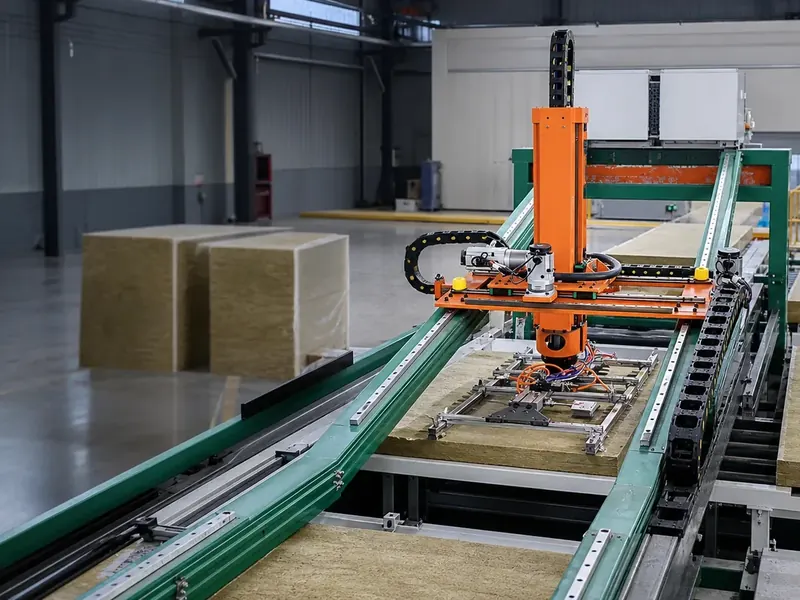
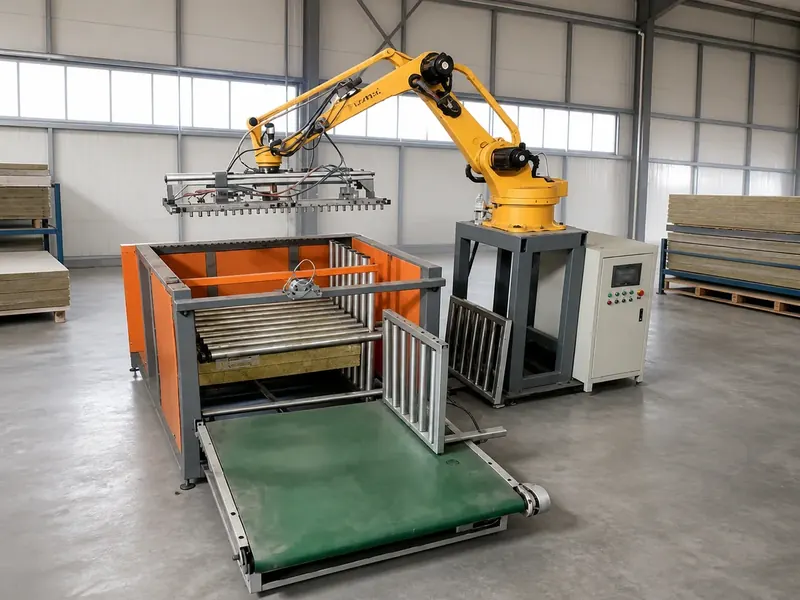
What do the current presentations specify?
| Item | Gantry | Robotic arm |
|---|---|---|
| Listed feed speed | Approximately 420 m/h | Approximately 400 m/h |
| Listed outline | 5.20 × 1.65 × 2.50 m | 2.90 × 1.45 × 1.25 m |
| Material information | 950 / 1150 formats; 50–200 mm thickness | Material and tooling fit require confirmation |
| Arm information | Gantry frame and gripper tray | 4 axes; 1,835 mm working radius; maximum stated payload 30 kg |
These are not results from a controlled head-to-head test. Do not use the speed difference to calculate a guaranteed production gain. Confirm the meaning of the 950 / 1150 formats against the supplier’s material drawing.
Does ±0.05 mm mean the insulation is placed that accurately?
No. The robotic presentation lists ±0.05 mm repeat positioning and separately lists 1 mm continuation accuracy. These describe different quantities. Arm repeatability cannot be substituted for material-placement accuracy or finished-panel tolerances.
Agree what will be measured, where the measurement is taken and the material used during acceptance. Ask whether the maximum stated payload includes the end tooling before evaluating the weight of the material alone.
How should I compare labour and changeovers?
Observe a complete shift workflow rather than only the automatic motion. Include bringing material to the cell, replenishing the stack, changing formats, handling interruptions and checking the output. Any staffing comparison should use the same production conditions.
The presentation includes labour-saving claims, but it does not supply an independently measured project baseline. Ask for a test plan and calculate the effect using your own staffing and operating hours. Avoid assuming that an automatic feeder creates an unattended production line.
What should a side-by-side demonstration show?
- The same material, placement pattern and receiving position.
- The complete cycle, including pickup, travel, release and return.
- The number of successful placements over an agreed run.
- Refilling access and what happens when the receiving line stops.
- Changeover tasks and required tooling for each material format.
Use the two product specification pages to shortlist a configuration, then submit the actual line drawing for review. Price comparisons should include the same tooling, controls, installation and acceptance scope.
Does the robot payload include the gripper?
Compare the complete moving load, not only the rock wool weight. FANUC’s selection guidance includes the product, end-of-arm tool and attached dress equipment in payload selection. KUKA’s load-analysis service also considers the centre of mass and inertia. FANUC palletising robot selection; KUKA Load: mass, centre of mass and inertia.
For a proposal, request a load summary covering the gripper, mounting parts, carried material and attached services, together with the proposed motion. A kilogram figure alone is not an approval for the application. These are general robot-selection references; they do not identify the robot brand fitted to our feeder or validate its stated payload.
What layout should the supplier evaluate?
| Drawing item | Question for the proposal |
|---|---|
| Pickup and placement positions | Can the proposed tooling reach every required position with the real material attached? |
| Full and nearly empty incoming stacks | How does the pickup sequence change as the stack is consumed? |
| Material replenishment and receiving line | Where are replenishment, receiving and maintenance areas shown in the complete layout? |
| Product changes | Which positions are programmed settings and which require tooling or mechanical changes? |
Request a layout and cycle study for both alternatives using the same brief. This is a procurement comparison, not a prescription for clearances or robot programming. Keep the machine outline, robot reach and complete installed working area as separate proposal fields.
Download one brief for both proposals
Prepare the actual material drawings and receiving-line information before requesting configuration-specific responses.
View editable project checklists. The original TXT is unchanged; completing it does not approve a configuration.
Quick comparison questions
Do 420 and 400 m/h prove a production advantage?
No. They are listed manufacturer-presentation figures, not a controlled head-to-head test or a guaranteed line-output comparison.
Does the same brief mean both arrangements are compatible?
No. Each proposal still requires configuration-specific material, tooling, layout and timing review.
Is the robotic arrangement always the smaller installed cell?
No. Keep machine outline and complete installed area separate, including loading, guarding and maintenance requirements.
Review the equipment
Send your workpiece and line requirements so the proposed scope can be checked.
Discuss your projectUpdated · Prepared by Color Steel Machine · Source basis: manufacturer product presentations and the industry references linked in the text. General planning guidance; not an installation manual. Machine-specific limits require written confirmation.
Terms and project templates
Clarify automation terminology or use the editable project checklists to prepare your line information.