Catalog ID F02 · Feeding
Robotic Arm Rock Wool Continuation Machine
A four-axis articulated system for intelligent tracking, pickup and continuous rock wool placement where flexible approach geometry is required.
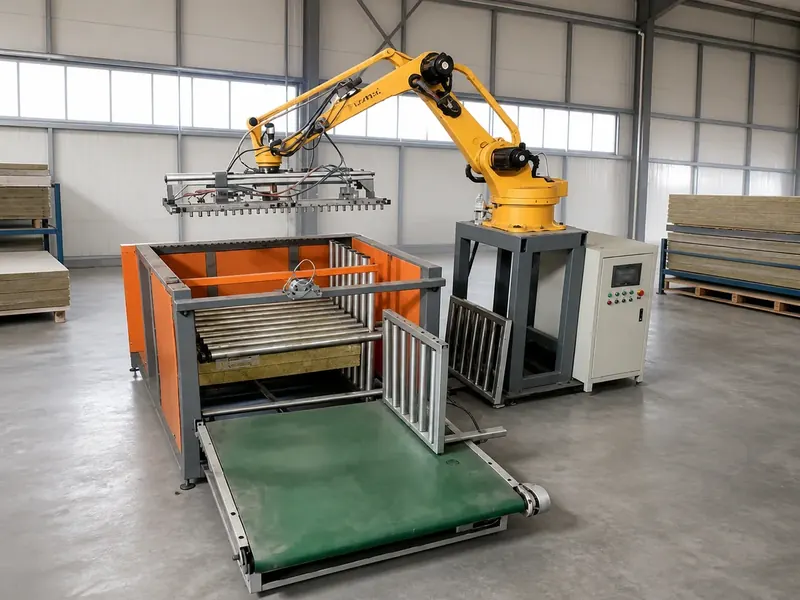
- Axes
- 4
- Maximum payload
- 30 kg
- Repeat positioning
- ±0.05 mm
- Operating speed
- Approx. 400 m/h
Application
Flexible pickup with intelligent tracking.
The robot follows the continuation process and places material with a presentation-stated continuation accuracy of 1 mm.
- 1,835 mm working radius
- 1.5 kW material-bin motor
- 380 V / 50 Hz power supply
- Compact 0.68 t equipment package
Presentation specifications
| Continuation method | Intelligent tracking |
|---|---|
| Continuation accuracy | 1 mm |
| Material bin | 1,250 × 950 × 700 mm |
| Total power | 7.32 kW |
| Overall dimensions | 2,900 × 1,450 × 1,250 mm |
| Weight | Approx. 0.68 t |
Material route
Start with prepared strips and the actual receiving pattern.
Describe each rock wool strip variant, its incoming arrangement and the requested delivery face and pattern. Identify who supplies cutting, turning and arranging before the continuation stage; do not assume those tasks are included.
For full-board transfer, review the column-type panel feeding route separately. For the same prepared-strip brief across alternatives, use the gantry versus robotic comparison.
Approximately 400 m/h is the presentation’s nominal operating-speed statement, not a sustained-output guarantee. Record actual material, placement pattern, replenishment and downstream stops when requesting a project-specific response.
Read the specification correctly
Three records for a configuration-specific proposal.
These diagrams explain specification terms and buyer inputs. They are not equipment drawings, robot programming, an acceptance method or proof of performance.
1 · Keep the figures separate
2 · Request a complete load record
3 · Link pickup and receiver records
The stated 1,835 mm working radius and equipment outline do not approve every pickup position, obstacle clearance or installed cell. Keep those catalogue fields separate from a supplier-reviewed layout with actual tooling and material.
- Rock wool dimensions, density and packaging
- Required pickup and placement coordinates
- Line speed and control handshake
- Available guarding and loading space
Prepare your feeding project
Record the prepared strip format, placement pattern, replenishment sequence and receiving conditions.
Continuation project inputs · Choose a feeding route · Gantry versus robotic · Existing-line integration
Project documents
Download the blank feeding-input brief.
Feeding project inputs · TXT
Complete the common and prepared-strip sections. Include all pickup and receiving positions, request a load summary, and mark unknowns as TBD. This blank brief is not an approval record.
Download input brief (TXT)Prepare the supporting records.
Use the continuation input guide alongside the brief, or browse the product download centre.
Before configuration
Common project questions
Does ±0.05 mm mean rock wool is placed that accurately?
No such guarantee is established. The presentation lists ±0.05 mm repeat positioning and separately lists 1 mm continuation accuracy. Neither should be substituted for a finished-panel tolerance; the project measurement definition and conditions need confirmation.
Can the machine always carry 30 kg of rock wool?
Do not assume that. Ask what the maximum stated payload covers and request the proposed tooling, mounting, carried material and attached-items load summary. This page does not calculate or approve a material load.
Does the working radius approve the complete cell layout?
No. The radius and equipment outline are presentation fields, not confirmation of every position or installed clearance. Send the actual pickup and receiving positions, tooling, material and layout revision for supplier review.
Is approximately 400 m/h sustainable project output?
Not automatically. It is the nominal presentation figure. A project response needs a stated material, pattern and timing basis, including how replenishment, changeovers and receiving-line interruptions are treated.
Next step
Send the material and cell records together.
Reference actual strip samples, pickup and receiving positions, the intended sequence and open load or timing questions. The web form does not accept attachments; send authorised drawings by email and reference their revisions in the enquiry.
Discuss the F02 configuration