Is a 20–30 second cycle enough for my line?
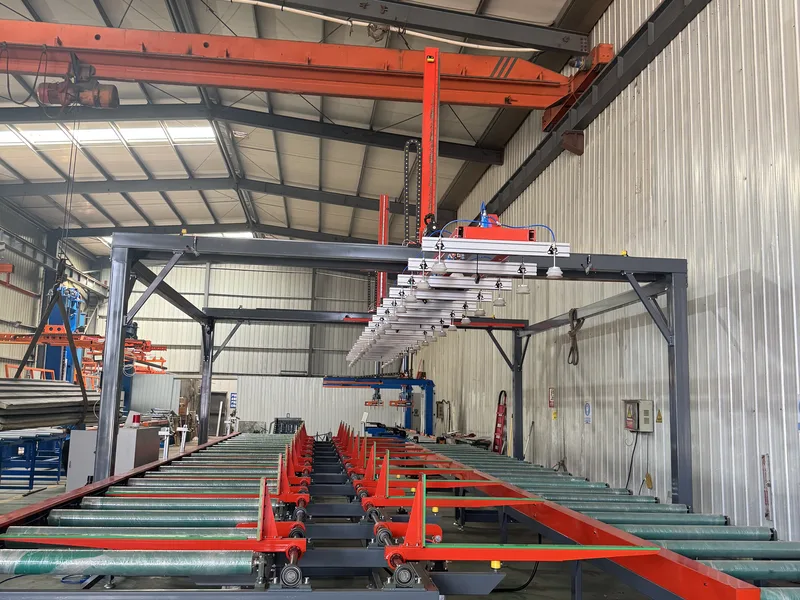
Only if the agreed operating cycle and downstream arrangement can handle the actual panel arrivals. The S04 product specification states a nominal cycle time of 20–30 seconds per panel. It does not guarantee sustained line capacity, bundle throughput or a particular turnover sequence.
Confirm what the timed cycle includes: pickup, travel, turnover if required, placement and return readiness. Separately record recipe changes, interruptions, full-stack changes and bundle removal. An arrival rate faster than the confirmed handling cycle needs a reviewed line arrangement; do not assume that a buffer is included.
How do I estimate the panel arrival interval?
For a continuous line with uniform panel length and no gap, a planning estimate is arrival interval (seconds) = panel length (metres) ÷ line speed (metres/minute) × 60. This is a simplified feed estimate, not a machine-capacity calculation. Measure actual arrival times at the stacker transfer point, including cutting and conveyor behaviour.
Estimate your panel arrival interval
For uniform-length panels on a continuous line, with no gap. Cutting, conveyor pauses and burst arrivals are excluded.
Enter your values to calculate an interval. This tool does not calculate machine capacity or approve a production setting.
Planning estimate only. The 20–30 s reference is nominal, not a verified cycle for your panel. No input is sent or stored by this tool.
Same line speed, different arrival intervals
| Panel length | Line speed | Estimated interval | Planning question |
|---|---|---|---|
| 6 m | 12 m/min | 30 seconds | What margin remains for the confirmed cycle and interruptions? |
| 4 m | 12 m/min | 20 seconds | Can the required motion and stack changes be completed without delaying arrivals? |
| 15 m | 12 m/min | 75 seconds | Can the long-panel configuration and downstream arrangement handle the actual product? |
The example speed is arbitrary. A longer estimated arrival interval does not establish pickup suitability or approve a panel's mass and dimensions.
Can I convert the nominal cycle into panels per hour?
Arithmetic gives 180 cycles/hour at 20 seconds and 120 cycles/hour at 30 seconds, if operation is uninterrupted. These are theoretical cycle counts—not promised output. They omit pauses, changes, faults, panel supply variation and completed-stack discharge.
Keep three measurements separate
- Handling cycle: the agreed start and end events for one panel.
- Arrival interval: the actual time between successive panels at the transfer point.
- Run output: accepted panels over an agreed representative period, with delays recorded.
What happens when a stack is complete?
Full stack → downstream handover
Confirm who removes the stack, how long the handover takes and whether the next panel can be received during that step.
Confirm whether a completed stack can leave while the next panel is being received. The stack support, discharge conveyor, wrapping handover and responsibility for each item should appear on the proposal and layout.
KINDUS describes bundle transfer as a downstream step; this is an industry example, not equipment included in our offer. Ask the supplier to review the available space and the intended stack-change sequence.
What should I send for a line-speed review?
- Minimum, typical and maximum panel lengths, actual mass and profile drawings.
- Measured arrival intervals, including short-panel batches and any burst arrivals.
- Line-speed range, cutting sequence, transfer height and conveyor layout.
- Turnover requirements, stack pattern, panel count per stack and bundle-removal method.
- Current stop causes, controls handover and requested scope of supply.
Use the retrofit checklist for an existing line and the acceptance checklist to agree a representative run.
Common cycle-time questions
Is nominal cycle time the same as guaranteed throughput?
No. Guaranteed performance, if agreed, must define the panel mix, cycle boundaries, run duration, downstream scope and permitted interruptions in the signed specification.
Will the stacker automatically suit any line speed?
No. Review actual arrivals and the complete sequence. The product's nominal cycle alone is insufficient.
Does the 2,000 mm stack-height figure describe panel thickness?
No. Stack height and individual panel thickness are different parameters. S04 states 0–2,000 mm stack height and 50–200 mm panel thickness, subject to the project arrangement.
Review your gantry stacking project
See the Automatic Gantry Flipping & Stacking Machine for Sandwich Panels and download its English product specification. Send the actual panel drawings, mass and line conditions for configuration review.
Send project requirementsUpdated · Prepared by Color Steel Machine. Configuration basis: the supplied manufacturer product document and confirmed 50–200 mm thickness range, reflected in the English product PDF. General planning guidance, not an operating or safety manual. The signed project specification and delivered-machine documentation govern.