Choose the matching machine
S01 · Panel stacker
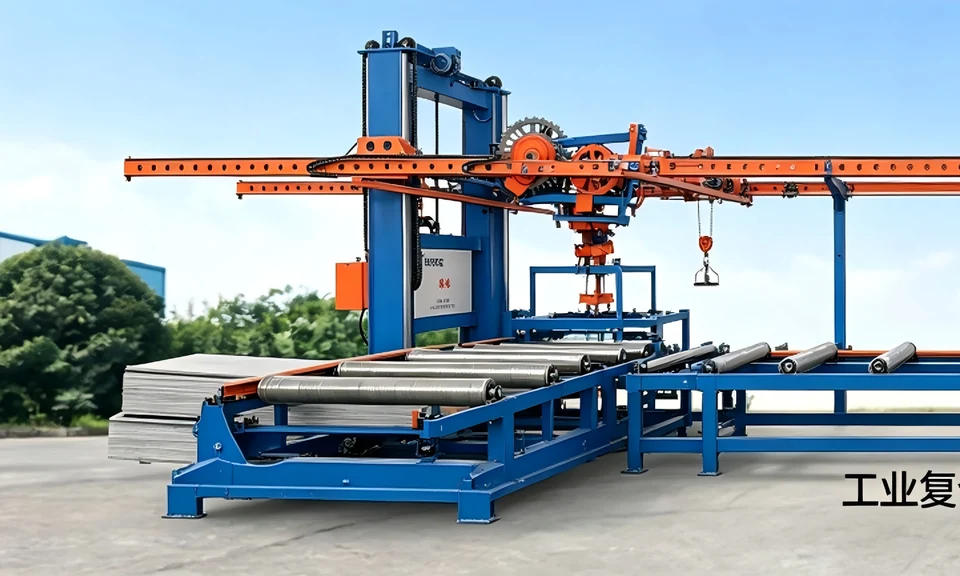
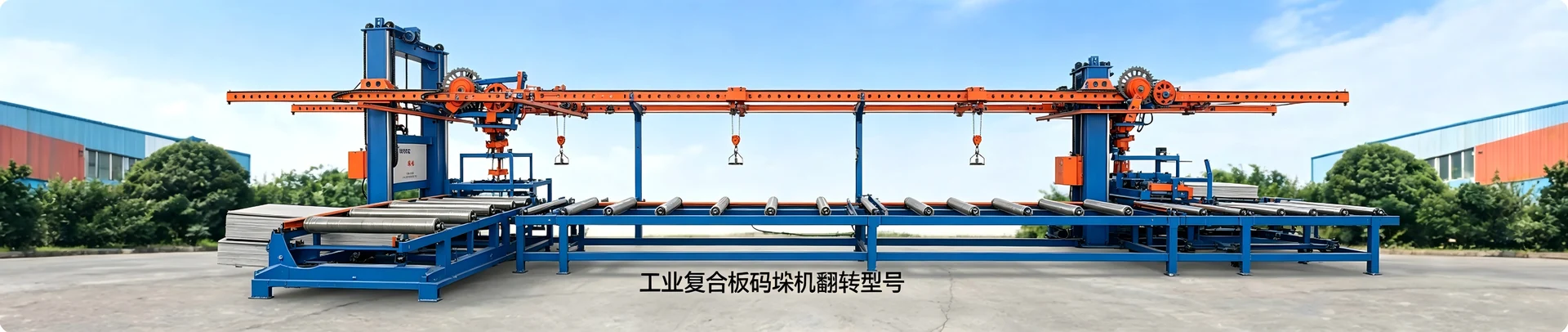
Turnover or non-turnover configuration: start with the panel cross-section, incoming face and finished bundle pattern.
Download S01 input sheetS04 · Gantry vacuum stacker
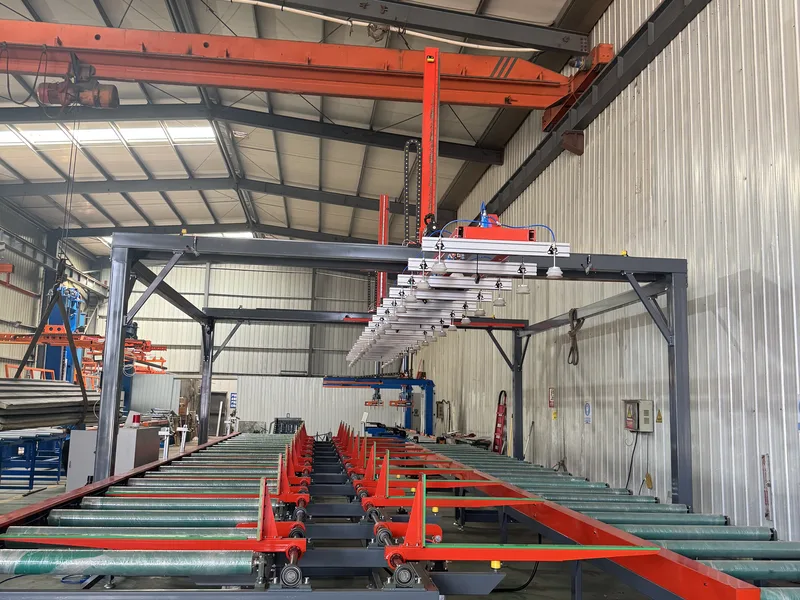
Vacuum pickup, flipping and stacking: check the actual contact face, panel arrival intervals and acceptance requirements.
Open product downloadsS01 and S04 have separate source documents. Payload, length, cycle time and tooling figures must not be transferred between them.
Explore this guide
What do you need to check next?
- Profile & turnover
- S01 input guideDrawings, face orientation and bundle pattern
- Vacuum contact face
- S04 pickup guideProfile, film and actual sample evidence
- Line arrival & discharge
- S04 cycle guideArrival intervals and completed-stack removal
- Acceptance & handover
- S04 acceptance guideAgreed samples, records and responsibilities
This is a reading map, not a prescribed operating sequence or approval of a machine configuration.
What determines the right stacker?
Panel geometry, the pickup face and the intended finished bundle are the starting points.
Read the planning detail
Panel geometry and the intended stack come first. Record whether the product is a flat wall panel or a profiled roof panel, its length, width, thickness and weight, and the permitted contact areas. Then show the stack orientation required for storage, wrapping or dispatch.
“Sandwich panel” here means a metal-faced building panel produced in a factory. Installation lifting equipment, aircraft composite panels and board presses have different tasks and should not be compared as equivalent stackers.
When is turnover needed?
Use the panel profile and desired bundle arrangement to decide whether turnover is needed.
Read the planning detail
Turnover depends on the panel profile and the approved stacking arrangement. Ribs and surface finishes can affect how neighbouring panels sit together. KINDUS discusses turnover for corrugated roof panels, illustrating why the profile drawing matters.
Our sandwich-panel presentation describes both turnover and non-turnover configurations. Send a cross-section and the desired stack arrangement before choosing between them. Do not assume that turning every second panel is appropriate for every profile.
How do vacuum and mechanical handling differ?
Check the actual contact areas. An industry handling method is not automatically an option in the CSM quotation.
Read the planning detail
| Method | What needs checking? |
|---|---|
| Vacuum handling | Accessible pickup surface, seal quality, profile, coating, protective film and behaviour during the intended motion. |
| Mechanical handling | Accessible support or gripping areas, edge condition, part stiffness and clearance during pickup and release. |
Both methods appear in KINDUS’s equipment description. That does not establish that both are offered in our current range. Our own tooling and contact method must be confirmed in the selected machine proposal.
Which length and stack-height figures can I use?
Use the current model and required motion together. S01 single-unit and dual-unit boundaries remain separate from S04.
Read the planning detail
The current S01 product 20261007 has a normal 2,500–12,000 mm single-unit range for stacking only or turnover plus stacking, with a recorded 0–2,500 mm single-unit stack height. Over 12 m without turnover, request a stacking-only single-unit project review. Over 12 m with turnover, discuss synchronized dual units.
The older presentation's 12/13 m references do not approve the current single-unit turnover of a 13 m panel. Dual-unit length, load, spacing, cycle and stack height need separate confirmation. See the long-panel decision guide and current S01 input guide.
Stack height is not panel thickness. These S01 routes do not change the separate S04 specification.
What should an acceptance run include?
Agree actual samples, required movements, surface checks and handover records before an acceptance run.
Read the planning detail
- Actual wall and roof profiles included in the order.
- The agreed size and weight extremes, including protective film if used.
- Pickup, turnover where required, placement and complete-stack removal.
- Surface inspection at the specified contact areas.
- Recipe changes, count confirmation and operator training.
Ask for manuals and a parts list tied to the delivered machine. A generic online manual or an illustrative control-screen image is not sufficient for commissioning or maintenance instructions.
Can bare rock wool and a metal-faced panel use the same vacuum setup?
No. An exposed core and a finished metal face are different pickup surfaces.
Read the planning detail
Do not treat the exposed core and the finished metal face as the same pickup surface. Schmalz describes different air-flow demands for permeable workpieces and suction-tight sheet metal, including leakage compensation in its SCPL product. This explains a selection variable; it does not prove that this component suits a particular sandwich panel. Schmalz SCPL: permeability and leakage.
In the enquiry, identify the contact face, profile, coating and any protective film. Request assessment using the actual sample and surface condition. Avoid specifying suction settings from a general web guide or assuming that a successful lift of one surface validates every product variant.
Does the stacker quotation include moving the finished bundle?
Not automatically. Separate stack formation from completed-bundle removal in the quotation.
Read the planning detail
Stack formation and bundle discharge should be separate items in the quotation. KINDUS describes transferring a completed bundle toward wrapping after stacking. Its process illustrates the downstream step, not equipment included in our offer. KINDUS sandwich-panel stacking system.
Mark the handover point on the layout: what supports the completed stack, what moves it onward, and which supplier provides that equipment? Ask whether the next panel can be received while the bundle is being removed. Record the answer alongside the intended bundle pattern and packaging method.
Gantry stacker selection guides
For the 4–15 m gantry vacuum flipping stacker, make three separate decisions before requesting the final configuration:
- Check pickup suitability: actual contact face, profile, film and sample evidence.
- Match cycle time to panel arrivals: measured intervals, stack changes and discharge scope.
- Prepare FAT and acceptance: agreed samples, criteria, records and handover.
The S01 selection routes above concern the separate S01 machine. Do not transfer its single-unit or dual-unit limits to S04. Use the S04 product specification for the gantry vacuum model and confirm the ordered configuration in writing.
Review the equipment
Send your workpiece and line requirements so the proposed scope can be checked.
Discuss your projectUpdated · Prepared by Color Steel Machine · Source basis: manufacturer product documents and the industry references linked in the text. General planning guidance; not an installation manual. Machine-specific limits require written confirmation.
Terms and project templates
Clarify automation terminology or use the editable project checklists to prepare your line information.
Continue with an S01 project
Prepare the panel and face records, review a panel over 12 m, or define the cost and supply scope. Each guide returns to the same S01 product reference.