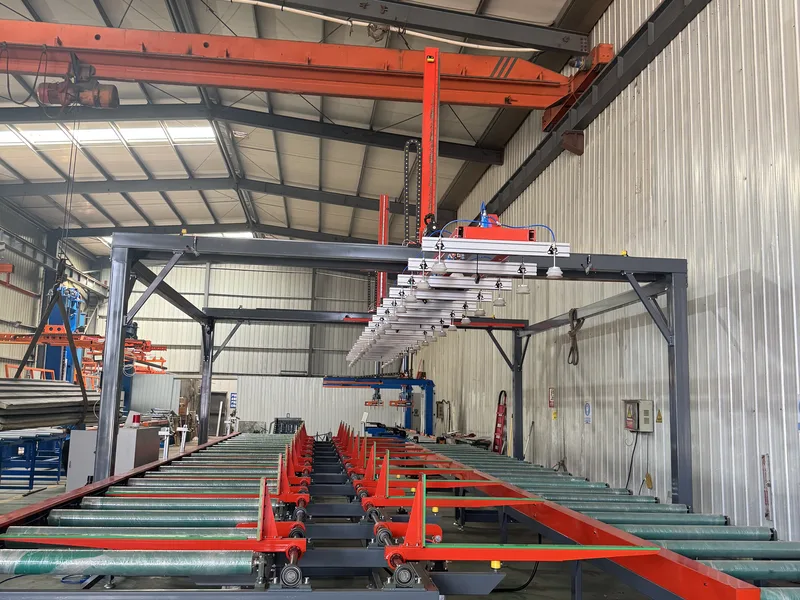
Can a gantry vacuum stacker handle PU sandwich panels?
PU sandwich panels are a stated application of our gantry flipping and stacking machine. Suitability still depends on the actual pickup face, profile, dimensions, mass and required motion—not the PU core name alone. Assess the finished panel and its surface condition before confirming the tooling.
The S04 configuration uses 24 suction cups, four servo axes and a stated maximum total handling load of 450 kg. Its panel-length range is 4,000–15,000 mm and the confirmed panel-thickness range is 50–200 mm. These figures describe configuration limits, not approval to combine every maximum in one panel.
Which surface information is needed?
Flat metal face
Show the actual contact face and its coating or protective film.
Profiled metal face
Supply a cross-section showing ribs, seams and usable contact areas.
- Identify the actual metal face contacted by the cups; supply a cross-section and photographs of the ribs, seams and usable contact areas.
- Describe the coating and protective film, including whether the film stays on during pickup.
- Record representative surface conditions, including dust, moisture or oil if these occur in production.
- Provide the real panel mass, dimensions and agreed stacking orientation for each product family.
Flat wall panels, profiled roof panels and cleanroom panels should be assessed separately. A successful test on one finish or profile does not validate another. Bare, porous insulation is not equivalent to a finished metal face.
Why do cup count and air pressure not prove suitability?
A cup must form an effective seal on the workpiece. Vacuum holding force depends on the pressure difference and effective suction area; the complete handling design must also address the intended motion and load. Schmalz explains these general vacuum principles. They are not a calculation approving this machine for a particular panel.
The specified 0.5–0.8 MPa supply is compressed-air pressure, not a vacuum holding-pressure setting. Do not derive a permitted load or alarm threshold from it, and do not multiply 24 cups by an assumed per-cup capacity. Tooling selection and operating settings belong in the machine-specific engineering documents.
What should a representative sample review cover?
Before the trial
Agree the test panel variants, contact faces, protective-film conditions and intended turnover/stack pattern. Include agreed size and mass extremes where available; clearly mark anything not represented by the samples.
Record the result
Record pickup, transport, turnover where required, placement and the condition of the surface after handling. Note the recipe, sample identification and any limitations. Supplier personnel should conduct the trial using the machine-specific procedures; this page is not an operating instruction.
Use the acceptance checklist to agree evidence and acceptance criteria before the test, rather than defining pass limits afterwards.
Common selection questions
Can it handle 15 m panels weighing 450 kg?
15 m and 450 kg are stated limits, but the combined case requires written confirmation for the actual panel, support arrangement and motion. Send the longest panel's drawing and measured mass.
Are all 50–200 mm thick panels suitable?
Thickness is only one input. Face geometry, sealing, stiffness, weight and turnover clearance also need assessment. Confirm each ordered product family.
Does this replace the product specification?
No. Review the gantry stacker product page and English product PDF for the stated configuration, then obtain a project-specific proposal.
Review your gantry stacking project
See the Automatic Gantry Flipping & Stacking Machine for Sandwich Panels and download its English product specification. Send the actual panel drawings, mass and line conditions for configuration review.
Send project requirementsUpdated · Prepared by Color Steel Machine. Configuration basis: the supplied manufacturer product document and confirmed 50–200 mm thickness range, reflected in the English product PDF. General planning guidance, not an operating or safety manual. The signed project specification and delivered-machine documentation govern.