Sandwich panel stacking & PE wrapping line

One gantry flipping and stacking machine. One full-stack PE wrapper. A coordinated path from individual panels to wrapped bundles.

A proposed end-of-line solution for long roof and wall panels currently handled manually.

Proposed arrangement, not an installed case study.

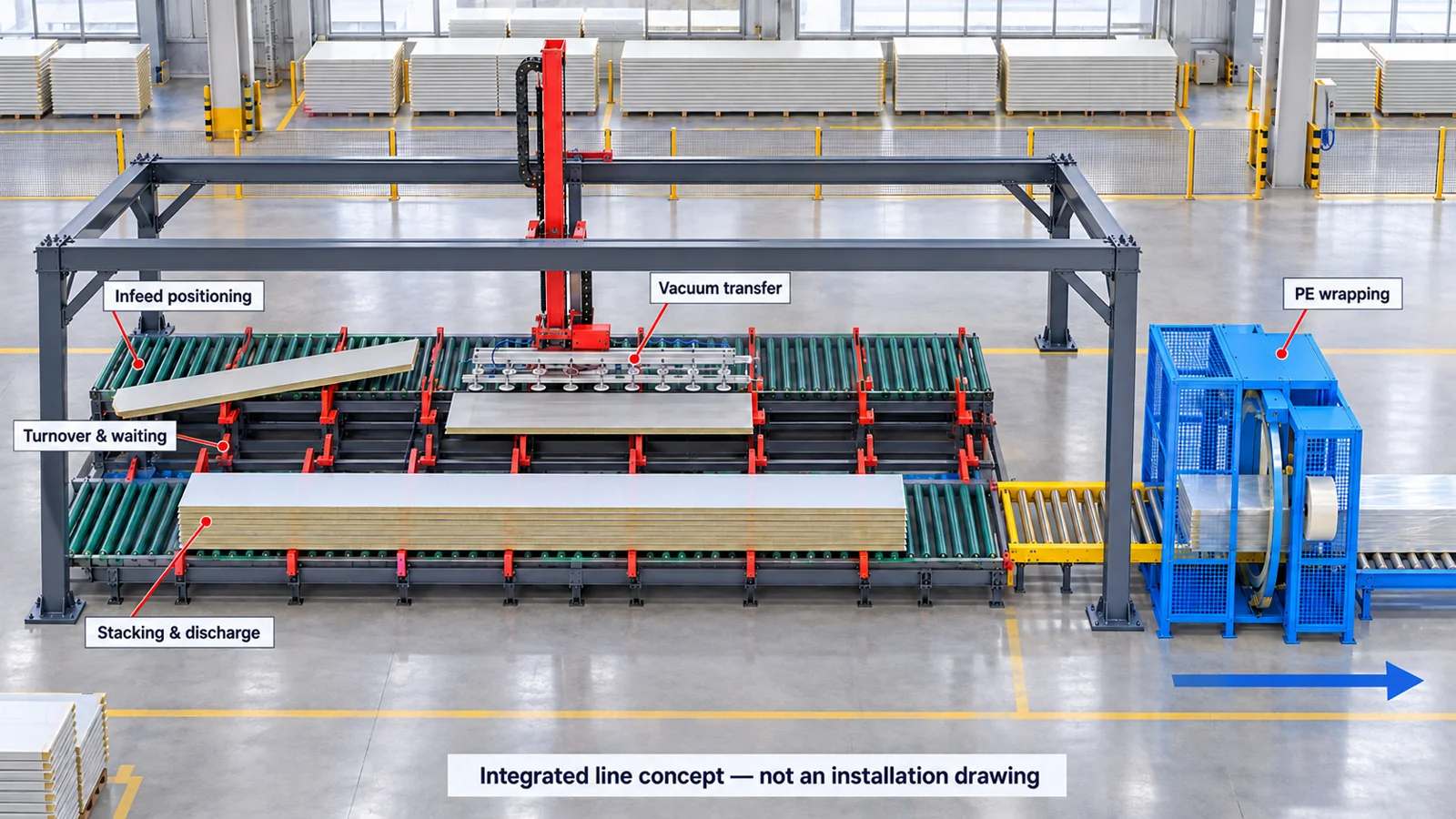
Concept: two outer roller beds separated by a narrow turnover waiting zone under an external-post gantry; the stacking bed feeds a PE wrapper inline
AI-generated explanatory concept based on the proposed process. Not a customer installation photograph, dimensioned layout or verified machinery geometry. The operating sequence is described below.
Open full concept ↗

Download the linked-line solution brief

Four-page English PDF with the concept arrangement, process sequence, reported project inputs, two-machine responsibilities and interface checklist. A proposed solution, not a compatibility approval or operating manual.

The problem: long panels, manual handling and a separate wrapping step

The producer reported manual feeding and stacking and wanted to automate finished-panel stacking and PE wrapping. Core-material feeding equipment was not part of the requested scope.

Long panels need distributed support. Roof-panel bundles require alternating face orientation, while wall panels are to keep their incoming orientation. Packaging must receive a complete stack, not wrap every panel separately.

These requirements make the handoff between stacking and wrapping as important as either machine on its own. Repeated manual positioning, turning and bundle movement are the steps this proposal is intended to reduce.

Reported project inputs

Maximum panel length
15,500 mm
Panel thickness variants
50 / 80 / 100 / 120 / 150 mm
Overall / effective width
1150 / 1000 mm
Reported maximum individual panel weight
Approximately 400 kg
Existing production-line speed
3–4 m/min
Requested maximum bundle height
1250 mm — wrapper interface to confirm
Packaging unit
Complete stacked bundle

These are enquiry inputs, not guaranteed capacities or measured output of the proposed line. A dimensioned site layout is still needed.

How the two-machine line works

The gantry spans three functional positions: the infeed roller bed, a narrow central turnover/waiting zone and the outer stacking roller bed. They are not three identical conveyors. Gantry columns sit outside the working beds.

  1. Convey and position the incoming panel

    The first roller bed receives a single finished panel and brings it to the handling position. Conveyor support is extended for the 15.5 m requirement.

  2. Set the required face orientation

    Turnover forks reverse selected panels into the central waiting zone. The planned roof-panel sequence alternates face direction; wall-panel handling keeps the requested original face direction. The central position is a turnover/waiting station, not a separate transfer conveyor.

  3. Pick from the waiting zone and build the stack

    The gantry’s level vacuum frame picks a panel from the central station and moves it across to the outer roller bed. It places individual panels into the agreed stack pattern. The vacuum frame does not perform the flipping operation.

  4. Discharge the completed bundle inline

    At the agreed bundle target, the outer conveyor starts and moves the whole stack lengthwise toward the PE wrapper. The wrapper’s conveyor follows the same direction as the stacker’s discharge conveyor — no sideways or right-angle transfer is intended.

  5. Wrap the full stack with PE film

    The PE wrapping machine receives the completed bundle for wrapping. Film specification, wrapping coverage, controls and final bundle removal are defined with the project, rather than assumed from the concept illustration.

Watch the handoff from panel turnover to full-stack wrapping

This 82-second CSM workflow concept follows the five steps above: receive one panel, set its face with mechanical turnover forks, transfer it level by vacuum pickup, build the bundle and discharge it lengthwise into the PE wrapper.

Source: Color Steel Machine’s own English concept animation. It is not equipment operating footage, an installed customer case or a timed performance test. The opening visualization is illustrative; the animated plan is not to scale or a validated machinery layout.

English narration and on-screen English captions · 1:22. Hosted by CSM, with no autoplay or video preloading. Watch on YouTube ↗

What to watch for

  • The narrow central position is a turnover/waiting station, not a third conveyor.
  • Mechanical forks change the panel face; the level vacuum frame handles transverse transfer and stacking.
  • Only the completed bundle leaves on the outer conveyor, travelling inline in the same direction as the wrapper conveyor.

Video takeaway: treat panel handling and whole-bundle packaging as one coordinated sequence, while checking bundle dimensions and weight, wrapper aperture, support, transfer height and controls separately. The animation does not establish compatibility or throughput.

Two machines, different responsibilities

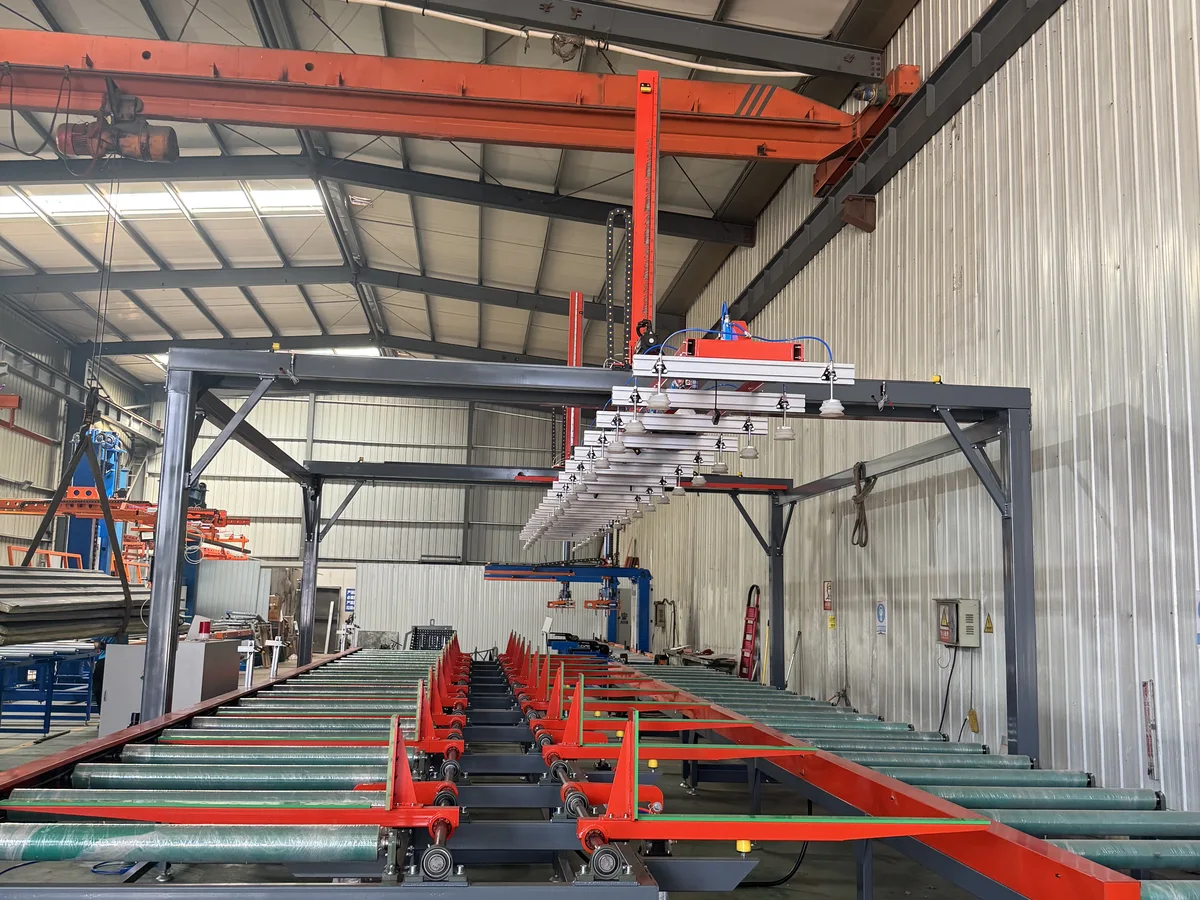
Manufacturer-supplied photograph of the gantry panel stacker, vacuum frame and roller beds
Equipment reference photograph. It is not a photograph of this proposed customer line.

Automatic Gantry Flipping & Stacking Machine

This machine handles individual sandwich panels: positioning, selected-panel turnover, vacuum pickup and placement into a stack. Mechanical turnover forks and the gantry vacuum frame perform separate jobs.

The published lifting configuration is rated at 450 kg. That individual-panel rating is not a completed-bundle rating. This proposal uses one gantry machine with extended conveyor support for 15.5 m panels; it does not call for two synchronized stackers.

The supplier’s proposed stacking-height limit is 2.5 m, but the working bundle height for this linked line must remain within the final PE wrapper aperture. This project-specific proposal does not replace the standard configuration information on the product page.

View gantry stacker →
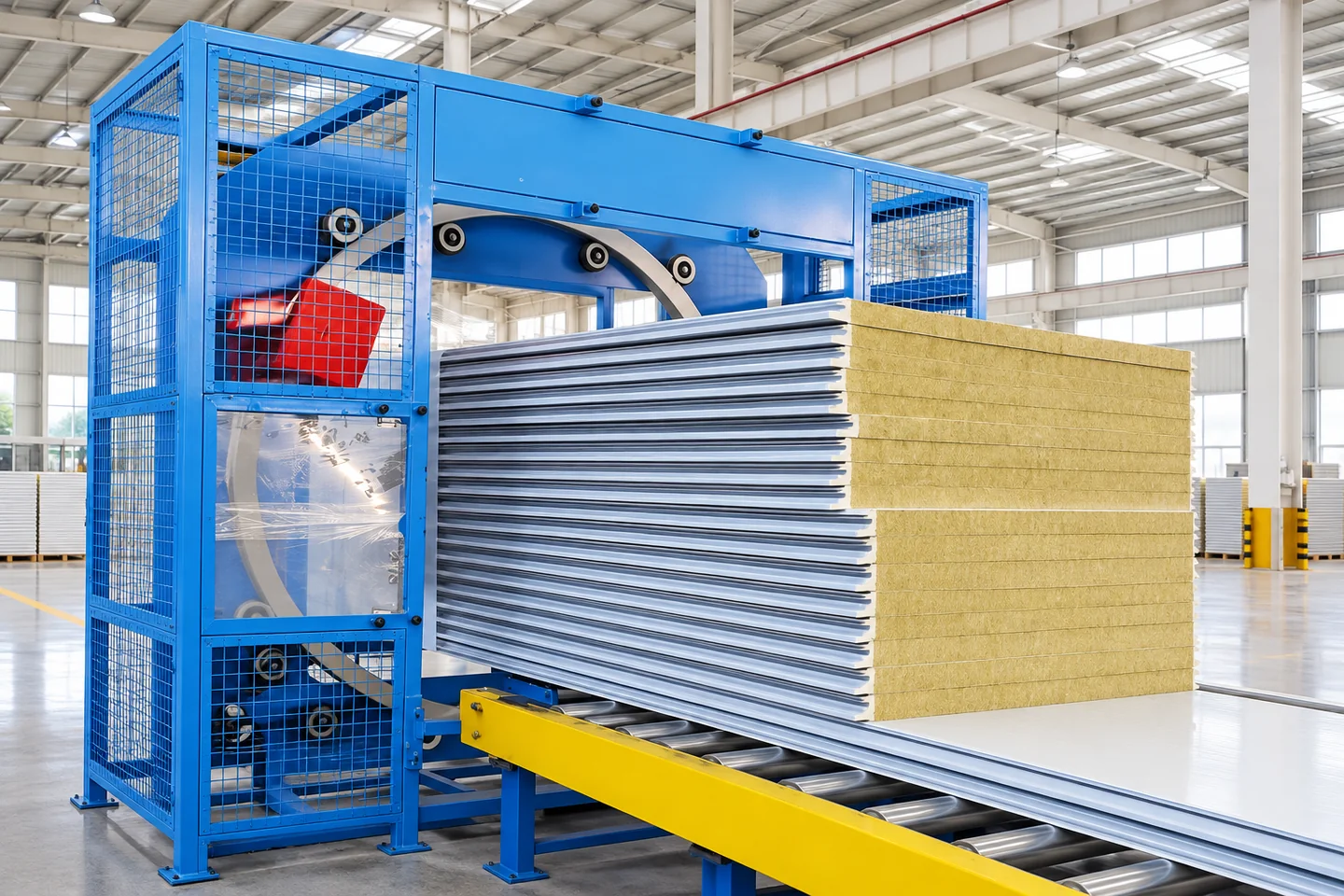
Concept visualization of the blue full-stack PE wrapping machine and yellow inline rollers
PE wrapper catalogue visualization, not installation or acceptance evidence.

Full-Stack PE Wrapping Machine

The downstream machine wraps complete bundles after stacking. It is a PE packaging stage, not a panel-turnover device, a vacuum stacker or a strapping machine.

The published configuration specifies a 3000 kg effective payload and a 1200 × 1200 mm package width × height. Total bundle weight must be checked separately from individual-panel weight.

Positioning the wrapper inline with the stacking outfeed is intended to remove a separate manual move to the packaging station. Support spacing, transfer level, wrapping coverage and discharge access remain part of the final line arrangement.

View PE wrapping machine →

Where the efficiency improvement is intended to come from

The proposal brings repeated handling steps into one controlled sequence. It targets the work between the production-line exit and the wrapped bundle, rather than changing the panel-making process.

  • Less repeated manual panel handling

    Positioning, selected-panel reversal and stack placement become coordinated equipment operations.

  • A defined roof-panel stacking pattern

    The face-up/face-down sequence is specified before stacking, instead of left to manual adjustment at the bundle.

  • Direct transfer into packaging

    The completed stack travels on the outer conveyor into the wrapper, reducing the need for an additional manual handoff.

  • One project review for both stages

    Panel support, bundle dimensions, transfer direction and controls are discussed together, so the wrapping stage is not selected in isolation.

No percentage saving, staffing reduction or delivered throughput is claimed. Actual results depend on panel arrival intervals, turnover sequence, bundle changes, wrapping time and agreed testing.

Confirm the interfaces before fixing the line layout

Length: extend receiving and discharge support for 15.5 m panels, then define the support arrangement, transfer levels, overall footprint and access with the layout.

Orientation: record the incoming face, roof-panel alternation and wall-panel non-turnover route. Agree how each recipe moves through the waiting position.

Timing: the reported 3–4 m/min line speed is an input. Panel lengths, cutting intervals, full-stack discharge and wrapper cycle determine whether the linked sequence matches actual arrivals.

Controls and access: agree ready-to-receive, bundle-complete and fault responses, as well as guarding, safe access and downstream removal. This page does not claim those interfaces have already been engineered or validated.

The finished bundle must fit the wrapper

1250 mm requested height vs 1200 mm standard wrapper height

The 50 mm difference remains an open interface item. Confirm a revised wrapper working aperture or agree a lower bundle target before treating the arrangement as compatible.

A taller stacker does not automatically allow a taller wrapped bundle. Use the final measured bundle envelope, including the stacking pattern and supports where applicable, rather than multiplying panel count by nominal thickness.

Check total bundle weight against the wrapper and every conveyor segment. An approximately 400 kg individual panel does not establish the weight of a full stack.

Questions about this linked-line proposal

How does the gantry stacker connect to the PE wrapping machine?

The outer stacking conveyor discharges the completed bundle lengthwise into an inline PE wrapping machine. The wrapper conveyor follows the same travel direction; transfer height, support, bundle weight and controls must be coordinated.

Does the vacuum lifting frame flip the panel?

No. Turnover forks perform the panel reversal at the infeed and central waiting stations. The level vacuum frame picks from the waiting station and places the panel onto the outer stacking conveyor.

How is the 15.5 m requirement addressed?

This proposal uses one gantry flipping and stacking machine with extended conveyor support for the 15.5 m panel requirement, plus one PE wrapper. The extension is project-specific and is not a change to all published standard configurations.

What determines the maximum bundle height?

The agreed working aperture of the downstream PE wrapper limits the finished bundle, even when the proposed stacker has a higher stacking limit. The requested 1250 mm height exceeds the published standard wrapper height of 1200 mm by 50 mm and requires confirmation or a revised bundle plan.

Is this an installed production line with measured efficiency results?

No. This is a proposed solution developed from an anonymized production enquiry and the supplier’s configuration explanation. The concept image is illustrative. Throughput, staffing and acceptance results are not yet measured.

Plan a stacking and wrapping line for your panels

Tell us where your current process needs manual handling and how the finished bundle should leave the line. We can discuss the gantry stacker and PE wrapper as one coordinated proposal.

Select the gantry stacker and mention “stacker + PE wrapper linked line” in your enquiry. Send drawings separately through the existing contact channels.

Include these project inputs

  • Panel drawing, maximum length, thickness variants and actual weight.
  • Overall width and effective width as separate values.
  • Incoming face, turnover sequence and finished bundle pattern.
  • Bundle width, height and total weight.
  • Line-exit level, arrival timing, available layout and removal route.