Catalog ID W01 · Welding
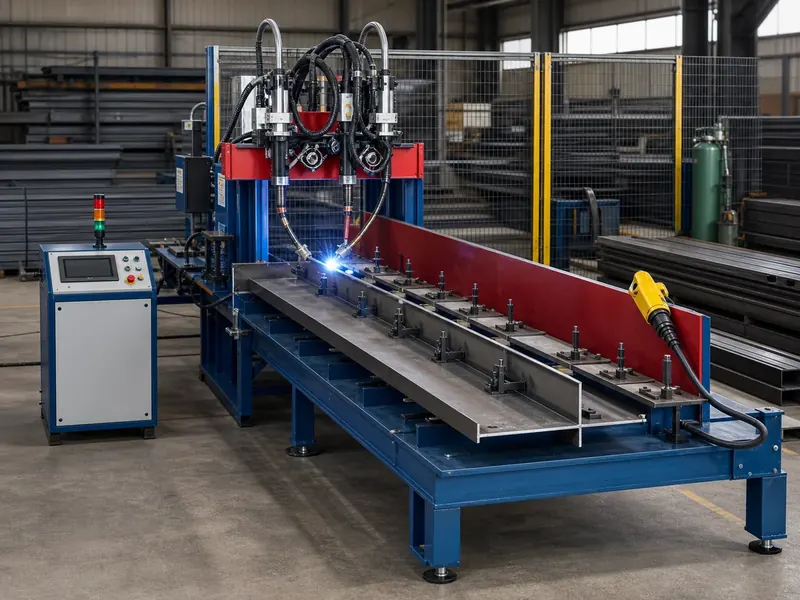
Automatic Purlin Cleat Plate Welding Machine
Dedicated positioning, clamping and twin-gun automatic welding for repetitive purlin cleat plate assemblies.
- Part length
- 0–450 mm
- Part width
- 0–200 mm
- Welding speed
- Approx. 1,500 mm/min
- Welding units
- 350 A × 2
Welding cell
A purpose-built fixture and motion sequence.
The cell uses a PLC plus motion module, servo travel and custom robot welding guns to repeat the cleat weld path.
- Wecon control and 10-inch touch screen
- 750 W servo with 30:1 precision planetary reducer
- Two XinSiLu 350 A welding units
- CO₂ or mixed shielding gas
Presentation specifications
| Overall dimensions | 3.24 × 0.93 × 1.80 m |
|---|---|
| Workpiece range | Length 0–450 mm; width 0–200 mm |
| Welding speed | Approx. 1,500 mm/min, adjustable |
| Control | PLC + motion module; 10-inch HMI |
| Drive | 750 W servo; precision planetary reducer, ratio 30 |
| Power supply | 220–380 V |
Application fit
Where this welding cell fits.
A dedicated cell is most useful when the part geometry and weld path repeat often enough to justify fixed locating and twin-gun motion. It is not positioned as a universal fabrication robot; sample parts, weld procedure and inspection criteria should be agreed before fixture manufacture.
Good project fit
- Repeated purlin-cleat and small connection-plate assemblies
- Batch work with stable datum points and weld locations
- CO₂ or mixed-gas welding processes covered by an approved procedure
- Projects that can provide part drawings, tolerances and sample welds
Before fixture review
Connect the assembly to its drawing references.
Use the actual part and weld drawings to describe the requested configuration. Keep unknown values open for review rather than assuming that the presentation range confirms a particular part.
What to prepare
- Geometry and revision
- Assembly and component drawing references, material grade and thickness.
- Weld definition
- Weld size and length references, shielding gas and the relevant procedure reference where applicable.
- Requested output
- Required output, counting boundaries and incoming preparation to discuss—not a guaranteed production rate.
- Quality responsibilities
- Inspection standard and evidence references, the responsible reviewer and unresolved questions.
- Purlin and cleat plate drawings
- Material grade and thickness
- Weld size, length and shielding gas
- Required output and inspection standard
Welding project preparation guides
Prepare the actual workpiece information and clarify the process scope before requesting the final configuration.
- Purlin Cleat Welding: Drawing & Fixture Inputs
- Automated Welding: Acceptance Evidence Preparation
- Tie-rod cutting & welding versus welding-only scope — use this separate guide if the project concerns tie-rods rather than cleat plates.
- Prepare a comparable quotation request
- Download welding preparation sheets
These guides organise purchasing information; they do not specify welding settings or acceptance limits.
Blank preparation sheets
Prepare the information before the enquiry.
Workpiece and project inputs
Collect drawing revisions, material and weld references, incoming condition and requested configuration. Unknowns can remain TBD.
Download inputs (TXT)Evidence and responsibilities
Identify procedure and evidence references, reviewers and open handover items. This blank sheet is not an acceptance protocol or sign-off.
Download evidence (TXT)The website enquiry form does not accept attachments. After the initial enquiry, send authorised drawings to tony.buy@gmail.com; do not send confidential information without permission.
Before requesting the W01 configuration
Does the presentation range confirm my part will fit?
No. Fixture and welding programme are confirmed against the supplied part drawing and weld specification. Use the listed values as presentation specifications, not a compatibility approval.
Is this a universal fabrication robot?
No. The existing application description is for repeated purlin-cleat and small connection-plate assemblies with stable datum points and weld locations. Sample parts, weld procedure and inspection criteria should be agreed before fixture manufacture.
Is welding travel speed the same as finished-parts output?
No production rate is established by the approximate adjustable welding speed listed here. Provide your required output and discuss incoming preparation and counting boundaries using the project-input sheet.
Can the download sheet approve weld quality?
No. The blank sheets organise purchasing information and evidence responsibilities. They do not specify welding settings or acceptance limits and do not replace the agreed protocol and actual reports.