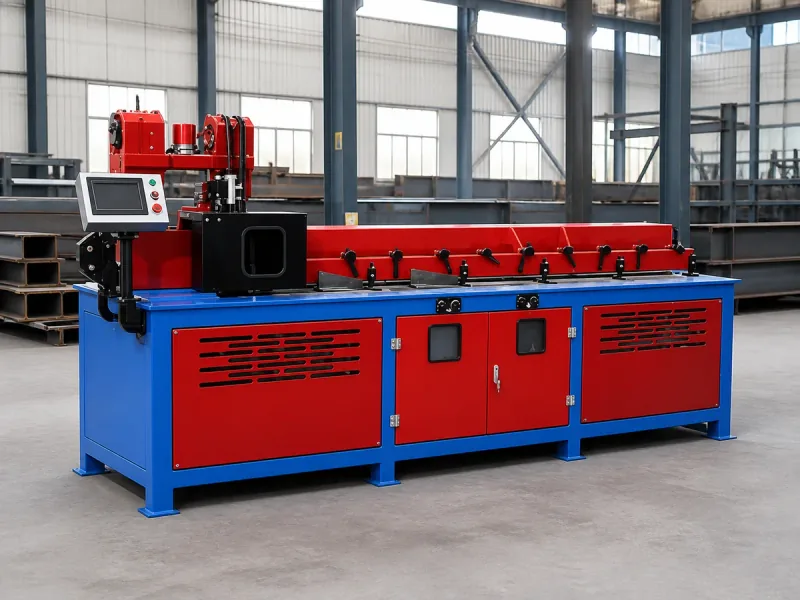
Which tie-rod configuration should I request?
Start with the condition of the incoming workpiece. If cutting is part of the requested machine scope, discuss the integrated cutting-and-welding configuration. If suitably prepared components arrive from an existing process, discuss welding-only. Confirm the actual drawings and incoming condition before selecting either configuration.
These are two configurations documented in our steel-structure welding presentation. The comparison concerns process boundaries—not a guaranteed difference in output, floor space, labour cost or return on investment. Here “tie rod” refers to the steel-structure assembly described by our product documents, not an automotive steering tie rod or a small formwork lock.
Two routes, different incoming conditions
Conceptual scope diagrams only. Boxes identify information to agree in a quotation—not an equipment layout, physical station order, operating instruction or guarantee of component readiness. The actual cutting, preparation and handling functions must be itemised for the project.
Define the incoming stock and the cutting requested inside the proposed cell. The documented integrated configuration includes a plasma station; do not assume every preparation or handling task is included.
Identify the upstream provider and the preparation completed before the components enter the proposed cell. The documented welding-only configuration excludes the plasma station; suitability still requires review of the actual components.
Keep the intended assembly list the same when comparing quotations. Record any difference in incoming condition and who owns it; neither diagram establishes that one route is faster, cheaper or more compact to install.
How do the process scopes differ?
| Selection question | Integrated cutting + welding | Welding-only |
|---|---|---|
| Incoming workpiece | Discuss the incoming stock and cutting required within the proposed cell. | Define the prepared components received from the upstream process. |
| Cutting station | A plasma cutting station is described in the integrated configuration. | The documented welding-only configuration excludes the plasma station. |
| Upstream responsibility | Confirm who supplies and presents stock and which preparation steps remain outside the cell. | Identify who supplies cut and prepared components and controls their incoming condition. |
| Handover | Define the requested completed assembly and the next handling step. | Define the requested completed assembly and the next handling step. |
| Quotation confirmation | Specify the included cutting and welding functions plus tooling and interfaces. | Specify welding functions plus tooling and interfaces; confirm the selected welding power-source package. |
What should be marked on the process boundary?
Before the machine
Identify stock or component supply, required preparation already completed, transfer method and who controls drawing revisions. Include the actual end-part drawings rather than a finished-assembly photograph alone.
Within the proposed machine
Ask the supplier to itemise the included cutting, locating, welding and handling functions. Do not assume that all upstream preparation or downstream inspection is included because the machine is called an integrated line.
After the machine
Specify the intended removal, transfer and quality-documentation handover. The supplier and buyer should identify which tasks require separate equipment or a different responsible party.
Does the shorter machine outline prove a smaller installation requirement?
No. A machine outline is not an approved installation layout. Space planning also needs the actual incoming stock, workpiece handling, service arrangements and downstream handover. Obtain the supplier's project layout rather than deriving a footprint from brochure dimensions.
The selected utilities and power-source package must be confirmed for the ordered configuration. The presentation's welding-only package is inconsistent between slides; the product page retains that disclosure. This guide does not choose between those ratings.
Match each scope question to a project reference
Prepare one baseline document pack for both proposals. The rows below map to the existing blank input sheet; they organise information and unresolved questions, not inspection criteria or automatic approval.
| Scope question | Reference to supply | Question to keep open |
|---|---|---|
| Which assembly is being quoted? | Assembly, rod or tube, and end-part drawing IDs and revisions; material and thickness references. | Are both proposals based on the same intended assemblies and drawing revisions? |
| What enters the cell? | Incoming-condition description and authorised component or sample IDs; note differences from intended production. | Is stock, a pre-cut workpiece or a prepared component set supplied, and by whom? |
| Where is preparation included? | Requested cutting and preparation scope, existing upstream process reference, and included/optional/excluded items. | Which cutting tasks belong in this quotation, and which remain outside it? |
| What changes between batches? | Variant list, batch mix, sample references and requested output with its measurement boundaries. | Which variants, changeover scope and output assumptions require project review? |
| Who owns the handover? | Loading, transfer and unloading responsibilities; existing-equipment and layout references. | Who provides incoming parts and receives the completed assembly at each interface? |
| Which documents and package apply? | Relevant procedure and quality-document references, responsible reviewers, and supplier confirmation of the selected power-source package. | What is confirmed, what is excluded, and what remains TBD? Do not resolve the documented package discrepancy by inference. |
Use the quotation checklist for commercial scope and the welding evidence preparation guide for document responsibilities. Project-specific procedures and acceptance requirements belong with the responsible reviewers.
What information should I send for a comparable quotation?
- Rod or tube and end-part drawings with revisions, material and thickness information.
- Incoming condition: raw stock, pre-cut workpieces or prepared component sets.
- Which cutting and other preparation steps are requested or already completed.
- The intended component variants, batch mix and required finished output.
- Existing equipment interfaces and responsibility for loading, transfer and removal.
- Procedure and quality-document references where applicable, with unresolved items clearly marked.
Use the same baseline for both configuration proposals. The quotation checklist helps record included, optional and excluded items.
Fill unknown input-sheet fields with “TBD”. The website enquiry form does not accept attachments; send authorised drawings to tony.buy@gmail.com after the initial enquiry.
Common configuration questions
Can both proposals use the same workpiece list?
Yes, use the same intended assemblies, but state the different incoming conditions and process responsibilities. Otherwise the scopes are not directly comparable.
Is welding-only always cheaper or faster?
No universal result is established here. Compare the quoted equipment, upstream preparation, handling and agreed output assumptions for the actual project.
Can I use general pipe-welding specifications for this equipment?
Do not assume equivalence. Heating elements, pressure piping, formwork locks and steel-structure tie-rod assemblies have different products and requirements. Use the actual assembly documents and the agreed machine scope.
Discuss the actual assembly and process scope
Review the matching machine specification, then send your workpiece drawings and the preparation information. Use a preliminary enquiry for unresolved items; the final configuration is agreed against the actual project.
Discuss configurationUpdated · Prepared by Color Steel Machine. Product scope basis: the supplied steel-structure welding automation presentation; terminology references are linked where used. Document and purchasing preparation only—not a welding procedure, fixture design, inspection method, acceptance standard or safety manual. Project-specific requirements and responsible reviewers must be identified separately.