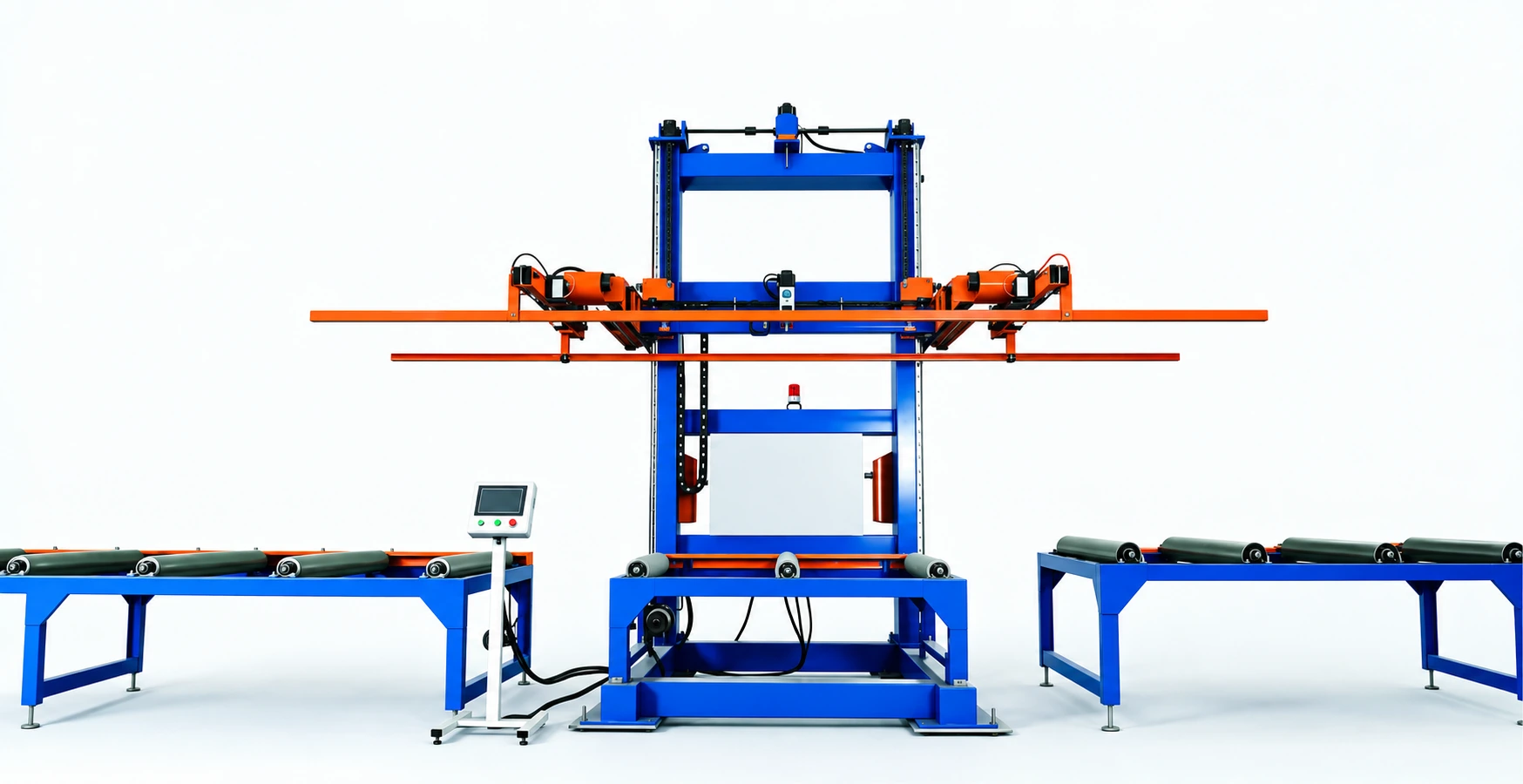
Supplied equipment illustration · not installation or acceptance evidence
Other Names of this machine:
上翻转复合板码垛机
upward turning composite panel stacker
EPS sandwich panel stacker
Choose by process
Stacking / turnover + stacking
20261007 turnover range
2,500–12,000 mm
Single-unit stack height
0–2,500 mm
20261007 control
VEICHI VC1 PLC
S01 selection · Pioneer 20261007
Three routes to the right stacker.
Choose the panel-length range first, then decide whether each panel must turn before placement.
01 / Standard single unit
2.5–12 m
Stacking only or turnover plus stacking. Normal operating range for product 20261007.
Documented single-unit stack height: 0–2,500 mm. Maximum individual panel working weight for the standard single unit: 240 kg. Above 240 kg requires customization or modification. Confirm each panel's width, thickness, core and profile.
02 / Stacking only
Over 12 m
A single-unit stacking-only configuration can be reviewed for the project. Maximum length and permitted panel combinations require engineering confirmation.
The 12 m normal turnover range does not establish the maximum stacking-only length.
03 / Synchronized dual units
Over 12 m + turnover
Discuss two synchronized units when longer panels must turn before stacking.
Maximum length, width, weight, cycle rate, support spacing and stack height are project-specific. See the dual-unit solution.
Workshop videos / single and dual units
See the handling sequence.
1 · Turnover and stacking
Single-unit lifting, turning and finished-stack placement.
Workshop footage illustrates the process. Final panel compatibility, capacity and layout require engineering review.
Long panels that need turnover: two linked units coordinate lifting, turning and placement. Review this separate configuration against your panel and line layout.
Review the longest panel, its width, thickness, weight, core and surface profile.
Confirm unit spacing, contact and support positions, synchronization and the required finished-stack face sequence.
Agree the target stack height, cycle rate, receiving height and finished-bundle removal interface.
The single-unit 2,500 mm stack-height figure is not a confirmed dual-unit rating. Dual-unit capacity, dimensions, controls and price require a project proposal.
Application
Single-unit technical reference.
Direct stacking uses lift and translation. Turnover adds rotation before placement. For long panels, decide whether turnover is required before selecting a single-unit or synchronized dual-unit solution.
Line-exit receiving conveyor
Servo lift and translation
Optional servo turnover axis
Powered roller conveyor
System and interface data
Panel length and motion
See the three selection routes above. The detailed 20261007 data below applies to the documented single unit.
20261007 stack height
0–2,500 mm
Conveyor length
10,330 mm
Power supply
Reference: 220 V translation / 380 V lift, 50 Hz. Confirm the complete incoming supply and site interface.
PLC
VEICHI VC1
Reducer
Impro RV reducer on turnover configuration
Configuration comparison
Two documented single-unit layouts.
Non-turnover stacker
Machine size
1,100 × 2,300 × 4,500 mm
Moving-arm travel
0–3,000 mm
Servo motions
Lift + translation
Conveyor motor
0.75 kW
Pioneer upward-turning stacker · 20261007
Lift, rotation and translation; selectable stacking-only or turnover-plus-stacking modes within the normal panel-length range.
Machine size
2,100 × 2,300 × 4,500 mm
Product code
20261007
Moving-arm extension range
1,500 mm
Normal panel length
2,500–12,000 mm
Maximum individual panel working weight
240 kg per panel for the standard single unit. Above 240 kg requires customization or modification.
Longer than 12,000 mm
Single-unit stacking only, subject to project review. For longer panels requiring turnover, discuss synchronized dual units.
Single-unit stack height in both modes
2,500 mm
Servo drive power
Lift 4.4 kW; rotation 1.5 kW; traverse 2.0 kW
PLC
VEICHI VC1
Servo motions
Lift + rotation + translation
Conveyor
10,330 × 1,220 mm
20261007 single-unit scope: normal 2,500–12,000 mm range, stacking only or turnover plus stacking; documented stack height 0–2,500 mm. Above 12 m, confirm a project-specific stacking-only range, or specify synchronized dual units when turnover is required. Single-unit dimensions and drives do not define the dual-unit configuration.
Configuration preparation
Record the panel, its faces and the finished stack.
Prepare one record per actual panel variant, tied to its drawing revision. The illustrations below explain the information to discuss; they do not approve a panel, contact method, layout or operating sequence.
1 · Choose the requested sequence
Conceptual configuration comparison based on the presentation. An added rotation axis is not approval of every panel profile, surface contact or stacking pattern.
2 · Label both panel faces
Conceptual face record, not a machine motion path. Send both-face photos, rib direction and the requested arrangement for successive panels; leave undecided items as TBD.
3 · Define the bundle handover
Conceptual scope record, not an installed layout. Identify separators, supports, alignment and removal responsibilities. Downstream packing and uninterrupted receiving are not assumed.
Panel record
Core material, cross-section, edges, actual length / width / thickness / weight combinations, both-face photos, film and coating restrictions.
Line-exit record
Incoming upper face, leading end, travel direction, receiving height, current layout revision and authorised process video.
Finished-stack record
Requested panel count and face sequence, alignment, separators and supports. Identify stack-removal timing and responsibilities separately.
The standard single-unit maximum individual panel working weight is 240 kg; above 240 kg requires customization or modification. Neither stack height nor conveyor size establishes a higher payload, pickup width or panel-thickness rating. Ask for the permitted combinations in the proposed configuration; do not use S04 vacuum-stack limits for S01.
Prepare the details once.
Show actual panel cross-sections, incoming and finished-stack faces, the requested turnover sequence and completed-bundle handover. Keep each variant tied to a drawing revision.
Four pages covering the documented single unit, stacking-only and synchronized dual-unit selection routes. The standard single-unit limit is 240 kg per panel; above 240 kg requires customization or modification. Unconfirmed width, thickness and cycle ratings are not supplied.
The S01 selection guide explains the drawings and photographs to prepare. The form accepts a summary, not attachments; send authorised files by email and identify their revisions.
How does the stacker synchronize with the sandwich panel production line speed?
The stacker does not need to run continuously at exactly the same speed as the sandwich panel production machine.
After the panel is produced and cut to length, it enters the stacker infeed conveyor. The conveyor accelerates and transfers the panel to the pickup position under the stacking gripper. When the position sensor detects the panel, the conveyor stops automatically. The gripper then picks up the panel and completes the required turnover and stacking operation.
Which solution should I discuss?
For 2,500–12,000 mm panels, discuss the 20261007 single unit with stacking only or turnover plus stacking. Above 12 m without turnover, request a project review of single-unit stacking. Above 12 m with turnover, discuss two synchronized linked units. Width, weight, thickness, material and profile must also be confirmed.
What is the maximum individual panel working weight?
The standard single-unit 20261007 machine has a maximum individual panel working weight of 240 kg. Above 240 kg, customization or modification is required. This is not a full-stack weight or a synchronized dual-unit rating. Panel width, thickness, core, profile and the required handling sequence still need confirmation.
Does the 12 m range mean longer panels cannot be stacked?
No. It describes the single-unit normal turnover and stacking range. A longer-panel stacking-only configuration can be reviewed for the project; its maximum length is not established by this page.
What must be confirmed for the dual-unit solution?
Maximum panel length, width, weight and thickness combinations, core and profile compatibility, unit spacing and support, synchronization, cycle rate, stack height, controls and site interfaces. The video illustrates a process and does not establish unlimited length or a guaranteed capacity.
Does the 2,500 mm stack height apply to dual units?
That figure is documented for the 20261007 single unit. Confirm the target stack height and permitted panel combinations separately for a synchronized dual-unit proposal.
Does stacking include wrapping and finished-bundle removal?
Only when the quotation explicitly includes those tasks and equipment. Supply the required stack arrangement, removal method and each interface owner separately.
Can I use the S04 gantry vacuum stacker ratings for S01?
No. They are separate catalogue machines. S04 load, pickup, thickness and cycle figures do not establish S01 capability; request confirmation against actual panel combinations.
Configuration review
Start with your panel. Define the solution.
Send the actual panel variants and your required handling sequence. We will review the single-unit, longer-panel stacking-only or synchronized dual-unit configuration with you.
Longest and shortest panel length, width, thickness and weight
Core material, flat or corrugated profile, film and coating restrictions
Stacking only or turnover plus stacking, by panel variant
Target stack height, face sequence and finished-bundle removal
Line discharge height, cycle rate and available footprint
Plan the next packaging step.
Once the stack is prepared, review the separate Full-Stack PE Wrapping Machine for horizontal film wrapping. Confirm full-stack weight and dimensions, conveyor transfer height and controls; this link does not establish automatic compatibility or included packaging scope.