Choose your stacking route
C/Z purlin sections
Prepare a section end view showing the web, flanges and lips. Label the incoming open side, then sketch the requested layer and finished bundle.
Profiled floor deck sheets
Prepare rib and edge geometry, overall and effective cover widths, and labelled incoming/output faces. Include the requested finished-stack arrangement.
Start with the actual workpiece, not its length alone. Our catalogue lists separate C/Z purlin and floor deck turnover stackers. Use the matching drawing and orientation checklist before requesting a configuration; the guides do not establish structural suitability or machine load limits.
Plan purlin and metal deck outfeed using section drawings, orientation, cycle timing, stack patterns and removal requirements.
Blank TXT enquiry aid for either route—not a machine programme, acceptance approval or installation drawing.
| Your workpiece | Prepare first | Continue to |
|---|---|---|
| C or Z purlin sections | Section end views, incoming open-side orientation and a layer/bundle sketch. | C/Z purlin drawing and bundle inputs |
| Profiled floor deck sheets | Rib and edge geometry, labelled incoming/output faces and a finished-stack sketch. | Floor deck turnover selection inputs |
Use the same profile stacking input sheet (TXT), completing the relevant product section. For sandwich panels rather than formed metal sections, use the sandwich panel handling guide.
Where does stacking fit in the line?
- Roll former & cutoffRecord actual part arrival intervals and the shortest production length.
- Receiving / outfeedLabel travel direction, discharge height and incoming orientation.
- Turnover & stackingChoose the workpiece route and define the requested layer or face sequence.
- Full-stack handoverAgree the removal method and whether clearing the stack interrupts production.
Are purlins and floor decks handled by the same machine?
Read the planning notes
Our current catalogue lists separate machines for C/Z purlins and floor deck sheets. They have different workpiece geometries and handling arrangements. Selecting by material length alone overlooks the cross-section, support positions and required turning motion.
This guide covers factory outfeed and stacking. Building spans, load capacity and the structural choice between C and Z sections belong to the project’s structural design, not to the stacker specification.
What do the product presentations establish?
| Equipment | Documented range | Configuration basis |
|---|---|---|
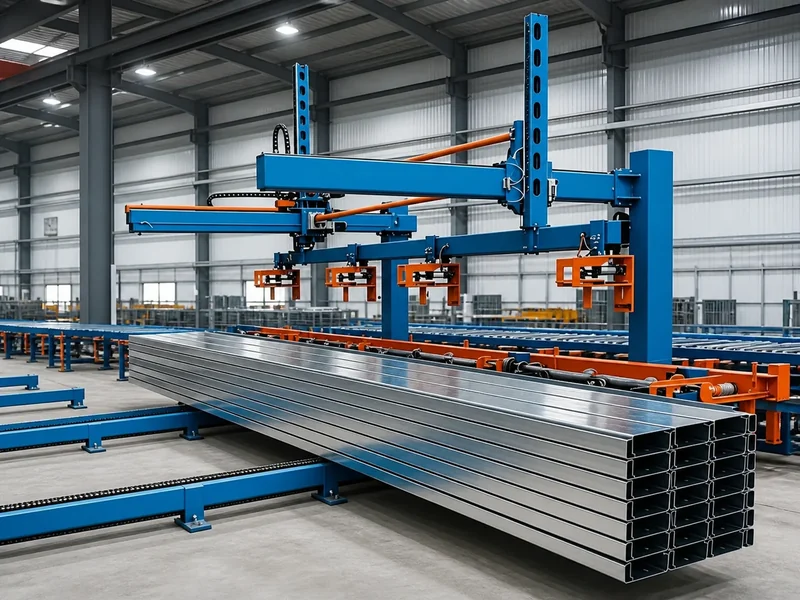
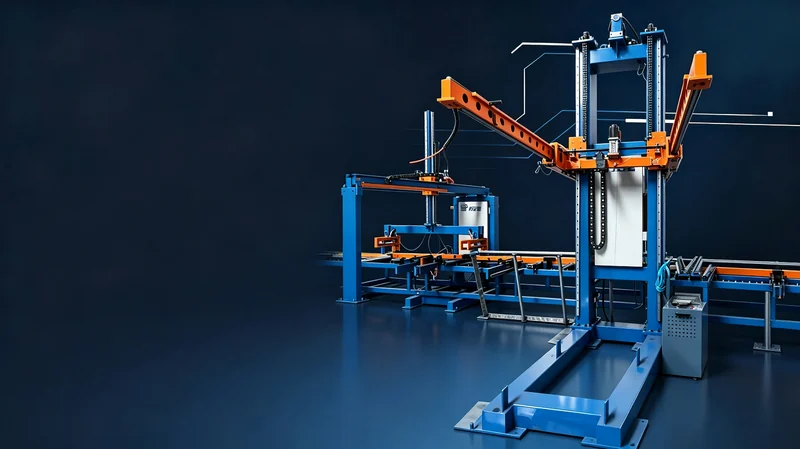
| C/U/Z purlin stacker · MCZ-Z-400-10 | 3,000–13,000 mm length; 100–400 mm width; 1.5–5 mm material thickness; 300 kg maximum lifting weight per individual profile | Two handling arms linked by a transmission shaft; positioning, gripping and layered mechanical turnover |
| Floor deck stacker | Presentation-listed 6–12 m length; 575 / 600 mm width entries (overall/effective definitions to confirm) | Mechanical turnover; nominal approx. 25 s cycle, with sheet and line conditions requiring confirmation |
C/U/Z selection limit: Do not select MCZ-Z-400-10 if any individual profile weighs more than 300 kg. This is a single-piece lifting limit, not the machine’s approximately 2.5 t self-weight or a finished-bundle load rating. Profiles at or below 300 kg still require section, tooling and stacking-arrangement review. This limit does not apply to the floor deck machine.
A listed width does not define every flange, lip, rib or material gauge that can be handled. The deck cycle is a presentation figure with no complete test conditions attached; it is not a production guarantee for every sheet.
Why do orientation and bundle pattern matter?
Read the planning notes
Show the purlin as it exits the roll former, including which way its open side faces. Provide the intended layer arrangement and bundle size. For floor deck sheets, show the profile, contact points and required face-up or face-down sequence.
ASC’s product page separately discusses C-section exit orientation, cycle conditions and bundle staging. These are useful issues to ask about; its supported profiles and options are not our machine specifications.
How do we avoid an outfeed bottleneck?
Read the planning notes
Use the shortest production length and fastest actual arrival interval when checking demanding operating conditions. Include any time needed to clear a full stack. A nominal roll-forming speed cannot by itself establish how frequently the stacker must pick up a part.
Map the complete route from cutting discharge to bundle removal. Identify available buffering, the movement of forklifts or other removal equipment, and whether removal interrupts stacking. Required buffers and protective measures are engineering decisions for the actual layout.
What should I ask about changeovers and spare parts?
Read the planning notes
- Which changes are recipe settings and which require mechanical adjustment?
- What tooling is needed for each approved section?
- Which components are wear items, and what part identifiers appear in the manual?
- Which electrical and pneumatic items are included in the final package?
- What evidence demonstrates the agreed profile range before dispatch?
Send a section drawing, minimum and maximum lengths, material gauge, individual weight, discharge height and bundle-removal plan. Different manufacturers’ parts should not be assumed interchangeable because their catalogue descriptions sound similar.
Does automatic stacking mean automatic profile changeover?
Read the planning notes
No—ask for the two functions to be described separately. Bradbury discusses adjustable bundle settings and a purlin-line range with differing levels of changeover automation. Its product-family description is not a promise that every stacker or existing roll former changes profile automatically. Bradbury: purlin stacking and changeover.
Prepare a product-to-product change list: section size, length, orientation and bundle pattern. Ask which changes use a stored recipe, which require adjustment, and which need different tooling. Request the demonstrated change sequence for the proposed configuration rather than a general “fully automatic” label.
What belongs in a bundle recipe?
Read the planning notes
Keep each approved workpiece, its incoming orientation and requested finished arrangement together. The details differ between purlin layers and deck sheet stacks: use the C/Z bundle preparation guide or floor deck orientation guide rather than copying one pattern across both products.
The blank project input sheet records the requested arrangement; it is not a machine recipe or programme.
Review the equipment
Send your workpiece and line requirements so the proposed scope can be checked.
Discuss your projectUpdated · Prepared by Color Steel Machine · Source basis: supplied export C-profile stacker specification (出口C型钢码垛机.docx), supplier-confirmed 300 kg single-piece lifting limit (11 October 2026), manufacturer floor-deck presentation and the industry references linked in the text. General planning guidance; not an installation manual. Machine-specific limits require written confirmation.
Terms and project templates
Clarify automation terminology or use the editable project checklists to prepare your line information.